



Governance
How GRONK's on-chain governance works: proposals, voting, treasury control and the venue registry.
The treasury belongs to holders
Most token treasuries are controlled by a multisig held by the founding team and described in a blog post as "community-governed." GRONK does it differently: the treasury is controlled by an on-chain governance module, and the founding team's voting weight comes from the same 5% allocation everyone can watch vesting. There is no veto.
What holders actually decide
- Yield destination — what share of routed yield goes to buyback-and-burn versus direct streaming.
- Venue registry — which contracts the kernel is allowed to route into.
- Treasury spend — every outflow from the governed treasury, including audits, integrations and incentives.
- Kernel parameters — the operational settings that sit inside governance-controlled bounds.
The proposal flow
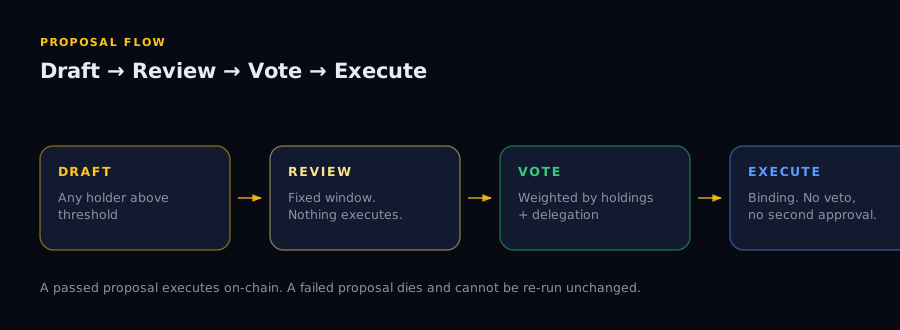
| 01 | Draft. Any holder above the minimum threshold posts a proposal, with a plain-language summary and the exact on-chain action. |
| 02 | Review. A fixed review window lets holders read the action and the venue or recipient involved. Nothing executes during review. |
| 03 | Vote. Weighted by holdings, one snapshot, one window. Delegation is supported for holders who can't vote every cycle. |
| 04 | Execute. A passed proposal executes with no second approval step. A failed one dies and cannot be re-run unchanged. |
Why the venue registry matters most
The most important thing governance controls is the list of contracts the kernel may route into. That list is the security boundary. A malicious venue added to the registry could drain routed capital — which is exactly why additions require a full proposal cycle, a disclosure of the contract, and a review window.
Governance is not a marketing feature
Governance only has value if it is used. If holders don't vote, the effective controller becomes whoever does — which is precisely the outcome governance exists to prevent. Part of the community allocation is reserved for active governance participants for this reason, and participation rate is published publicly every cycle.
Route the attention. Keep the value.
Read the mechanism, then decide. No presale, no private round, no custody.